


Female Infertility Tests: Types, Process & Diagnosis
- BLOG
- Female Infertility Tests: Types, Process & Diagnosis
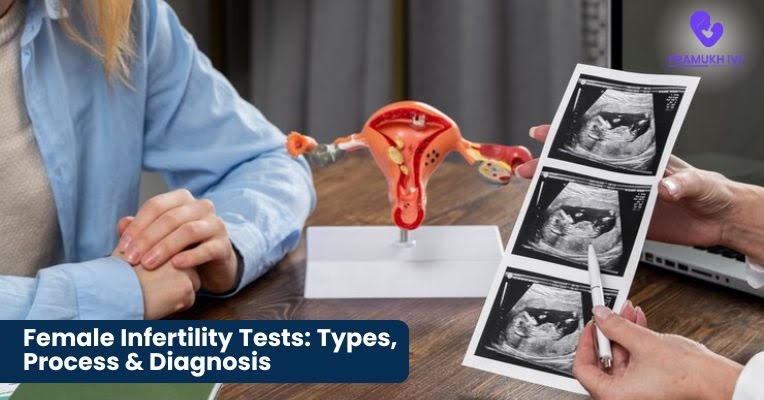
Infertility means a couple cannot conceive after a certain period of trying. When infertility involves the woman (female infertility), doctors use various tests to find out why. Early diagnosis helps in choosing the right treatment and improving chances of pregnancy. In this article, we’ll cover what tests are done, how they are done, and what the results mean.
At Pramukh IVF Center, we use advanced technology and expert care to perform thorough female infertility tests, helping identify the cause and design a personalized treatment plan to improve the chances of pregnancy.
Why Are Female Infertility Tests Important?
Female infertility tests at Pramukh IVF Center are important because they help identify underlying issues early, allowing for personalized treatment and better chances of pregnancy.
- To know the exact reason for difficulty in conceiving
- To check if there are problems like blocked tubes, hormonal imbalance, or issues in the uterus
- To decide the right treatment quickly and save time
- To reduce stress and increase chances of pregnancy
Doctors usually recommend tests if:
- You are under 35 and trying for 1 year without success
- You are above 35 and trying for 6 months without success
Types of Female Infertility Tests
Below are the major categories of tests, what they check, and how they are done.
Types of Infertility Tests Services We Provide

Infertility Workup
A series of tests done to form an effective treatment plan for an infertile couple.

Semen Analysis
A clinical procedure to determine the production, count, quality, and other factors of the sperm in the semen.
Sonography
A test that uses high-frequency sound waves to scan the reproductive organs of a woman before, during, and after getting any kind of fertility treatment.
Conclusion on Female Infertility Tests
Infertility can feel stressful, but remember, you are not alone. With the right Female Infertility Tests and Infertility treatment, many women successfully become mothers. At Pramukhi IVF Center, we provide complete infertility evaluation and personalized treatment to give you the best chance of pregnancy.
If you have been trying for a long time, it may be the right time to consult us.
FAQ
1. When should I go for Female Infertility Tests?
If you are under 35 and have been trying to conceive for 1 year, or above 35 and trying for 6 months without success, doctors usually recommend Female Infertility Tests to check the reasons.
2. Do I need all types of Infertility Tests?
Not always. The doctor will suggest the right Female Infertility Tests based on your medical history, age, and symptoms. You may need only a few tests, not every test.
3. Are Female Infertility Tests painful?
Some Female Infertility Tests like blood tests and ultrasound are painless. Tests like HSG or hysteroscopy may cause mild discomfort, but doctors usually give medicines or anesthesia to reduce pain.
4. How much do basic Female Infertility Tests cost in India?
A basic hormone panel (FSH, LH, TSH, Prolactin, AMH etc.) generally costs between ₹1,000 to ₹4,000 depending on the lab and city.
5. What is the difference between Female Infertility Tests and male infertility tests?
Female Infertility Tests focus on the woman’s reproductive system (ovaries, uterus, tubes, hormones). Male tests check sperm count, movement, shape, etc.
6. Can regular periods mean I am fertile?
Not always. Even with regular periods, there may be other issues like hormone imbalance, blocked tubes, or low egg quality. Tests help find those.
7. How accurate are Female Infertility Tests?
Many tests are very good, but none are perfect. Some issues may be missed; sometimes doctors have to repeat or combine different tests to get a full picture.