


How IVF Works: From Egg Retrieval to Pregnancy
- BLOG
- How IVF Works: From Egg Retrieval to Pregnancy
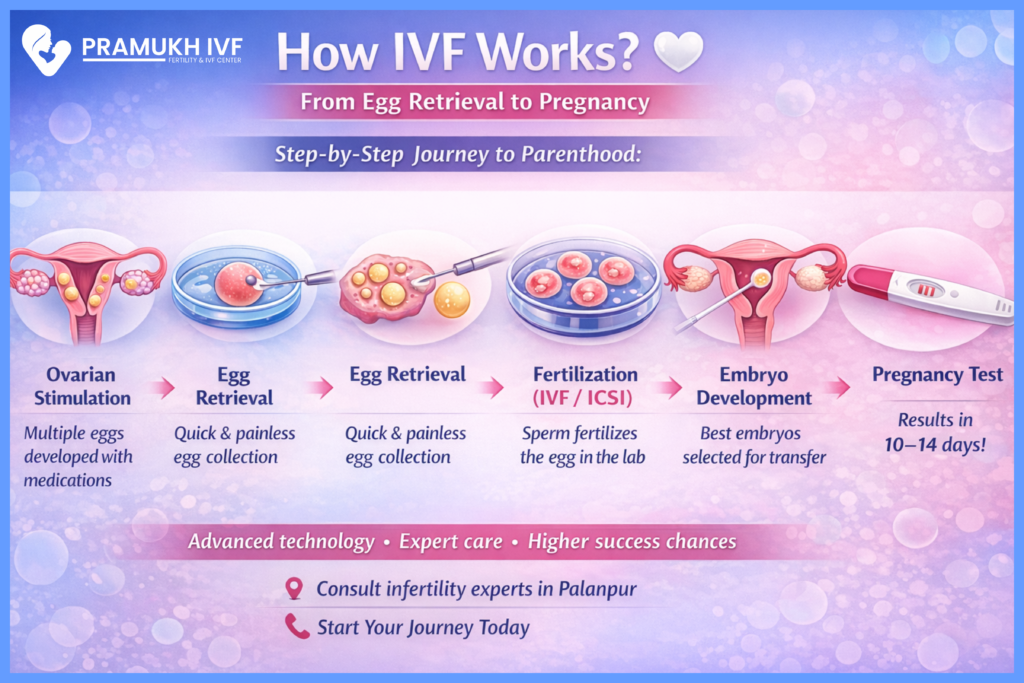
In vitro fertilization (IVF) is one of the most effective and widely used fertility treatments available today. It has helped millions of couples overcome infertility and achieve their dream of parenthood. IVF involves a series of carefully monitored steps that assist in fertilization and embryo development outside the body before transferring the embryo into the uterus.
Understanding how IVF works can reduce anxiety and help couples feel more confident about the process. Infertility experts in Palanpur provide personalized IVF treatments using advanced technologies, ensuring higher success rates and safe outcomes.
In this blog, we will explain the IVF process step by step—from egg retrieval to pregnancy—along with frequently asked questions to guide you better.
Step-by-Step IVF Process
1. Ovarian Stimulation
IVF treatment starts with ovarian stimulation in order to induce development of many eggs rather than one, which is usually released every month. The use of fertility drugs and hormones for this process is recommended.
Ultrasound and blood tests are performed periodically to monitor follicle growth, since follicles develop eggs inside them.
2. Egg Retrieval
Once the eggs are mature, a minor surgical procedure called egg retrieval is performed. It is usually done under mild sedation and involves collecting eggs from the ovaries using a thin needle guided by ultrasound.
The procedure is quick and generally painless. The collected eggs are then sent to the laboratory for fertilization.
3. Sperm Collection and Fertilization
On the same day as egg retrieval, a sperm sample is collected from the male partner. The healthiest sperm are selected for fertilization.
In some cases, advanced techniques like ICSI (Intracytoplasmic Sperm Injection) are used, where a single sperm is directly injected into an egg. This is especially helpful in cases of male infertility such as low sperm count or poor sperm quality.
4, Embryo Development
Once the embryos have been fertilized, they will be observed in the lab for some days, during which time the experts monitor their growth and viability to choose the best embryo for transfer.
Embryo health is a key factor in raising the probability of conception.
5. Embryo Transfer
The selected embryo is transferred into the woman’s uterus using a thin catheter. This is a simple and painless procedure that does not require anesthesia.
After the transfer, patients are usually advised to rest and follow specific guidelines provided by their infertility expert in Palanpur.
6. Pregnancy Test
A blood test will be conducted after 10-14 days following the implantation of the embryo to confirm whether there was pregnancy or not. In case the embryo implants successfully, then pregnancy will take place.
It is important to note that follow-up care becomes necessary at this point.
Conclusion
IVF is an excellent fertility treatment for people who suffer from infertility problems. Every process involved in IVF treatment has been carefully developed with the goal of increasing its success rate.
With the help of a competent infertility specialist in Palanpur, along with the use of ICSI technology, many infertile couples can successfully have their children. Getting advice early on and being diagnosed properly are key factors in the success of IVF procedures.
If you are thinking of undergoing an IVF procedure or are having trouble getting pregnant, you should not hesitate to seek medical help.
Related Blogs
Frequently Asked Questions
Describe the egg retrieval stage in vitro fertilization.
This procedure involves the collection of mature eggs from ovaries through a thin needle. The process requires minimal sedation and lasts 15-20 minutes.
How eggs are fertilized in vitro fertilization?
Once obtained, eggs are introduced into a laboratory environment and mixed with sperm. In some instances, a single sperm cell can be inserted directly into the egg using the intracytoplasmic sperm injection method.
How long embryos develop in vitro fertilization?
The development of embryos is assessed in laboratories for three to five days. Embryologists evaluate their viability and choose the best embryo for transfer.
Describe the embryo transfer step and whether it is painful?
This is a straightforward process that does not involve any pain. The selected embryo is transferred into the uterus with the help of a catheter. This technique does not need anesthetic treatment.